
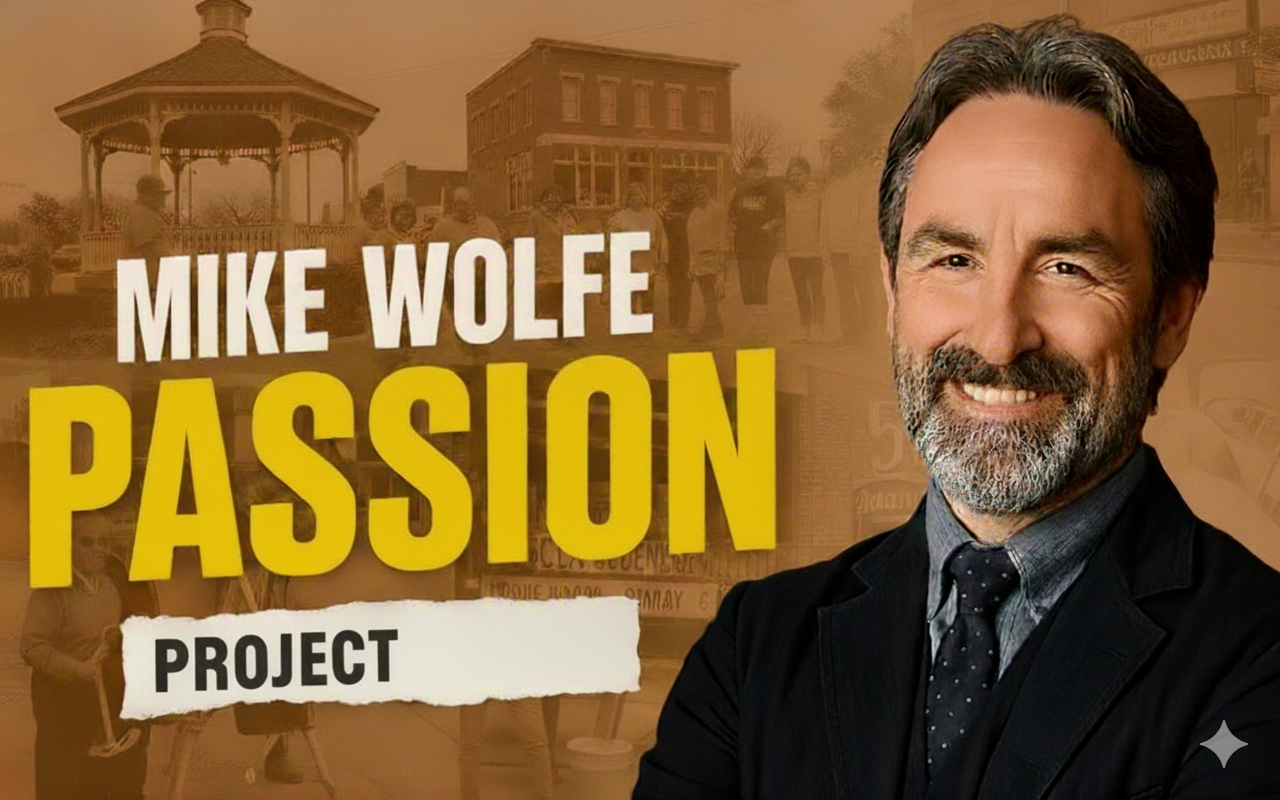
When you hear the term Mike Wolfe passion project, you’re thinking of more than just dusty barns and rusty motorcycles. You’re thinking of a deep-rooted mission to honour America’s past, to preserve its hidden stories, and to breathe fresh hope into its quiet corners. Much more than the show-biz glare of American Pickers, this initiative is heartfelt, grounded, and community-focused. In the first few paragraphs, I want you to sense that this project is personal. I want you to feel part of something bigger: the revival of places we might have passed without notice.
In the following sections we’ll explore how Mike Wolfe’s project started, how it works, why it matters, and how you—yes, you—can engage with it too. We’ll look at real examples, the challenges, the wins, and the broad cultural impact.
Mike Wolfe Passion Project: What It Is
The phrase “Mike Wolfe passion project” refers to more than a collection of vintage finds. It refers to a purposeful effort by Mike Wolfe to invest in historic buildings, to support craftspeople, to celebrate the old and make it relevant for today. He is not merely hunting antiques; he is rescuing stories.
He began as a picker, yes—roaming barns and exploring rural America for hidden treasures. But over time, he realized: the treasures weren’t just the items themselves, but the places, the buildings, the communities that held them. The project asks: what if we restore the spaces, the architecture, the small-town main streets? From that insight, the initiative evolved.
So when we talk about the “Mike Wolfe passion project,” we mean his overarching mission: preservation + storytelling + community revival.
How the Idea Began
Growing up in Bettendorf, Iowa, Mike Wolfe was endlessly curious about old tools, signs, bikes, barns. He had that explorer’s hunger—looking at things others discarded and wondering about their story. That early curiosity laid the foundation for everything that followed.
Then, through the TV show, he traveled widely. He saw countless artifacts, sure—but he also saw towns fading, storefronts empty, historic architecture left to decay. He realised the problem wasn’t just forgotten barns; it was forgotten communities. And that became the spark for the project.
Hence, the transition: from picker to preservationist. From finding objects to restoring structures. From selling antiques to telling heritage stories. That shift is what makes the initiative meaningful—it’s not just about the past, but about what the past can bring to present-and-future.
The Core Components of the Project
To understand how the Mike Wolfe passion project operates, it helps to break it down into its key strands:
Historic Building Restoration
Mike acquires old buildings—often in small towns, often in neighbourhoods under-revived—and works to restore them while retaining character: tin ceilings, original façades, vintage signage. For example, in Columbia, Tennessee he helped convert a neglected industrial strip into a lively alley of creative studios and shops.
This approach is about adaptive reuse: the building is honoured, yet given a purpose for today.
Supporting Artisans and Craftspeople
Another pillar is craftsmanship: the old skills, the hands-on trades that built America. Mike uses his platforms (like the brand Two Lanes) to spotlight artisans—metal-workers, neon-sign makers, saddle-builders—and often provides micro-grants to help them sustain their work.
It’s about keeping these skills alive and building economic vitality for makers, not just preserving relics.
Storytelling and Media
Restoration isn’t enough if no one knows the story. Mike uses social media, blogs, and his retail-spaces (e.g., the offices of his brand or stores) as storytelling hubs. The stories behind the objects and buildings become the glue that connects people emotionally.
As one article put it, “the real treasure wasn’t just the items he found, but the towns and buildings that held them.”
Community & Economic Revitalization
When you restore historic buildings and then fill them with small businesses, studios, cafés, you revive not just the building—but the town’s identity and economy. Mike’s work is clearly about that. In small towns, this kind of heritage restoration can boost tourism, create jobs and renew community pride.
This component reveals that the project isn’t just sentimental—it’s practical and impactful.
Notable Examples in Action
Theory is fine—but what’s real? Here are a few examples of how the project unfolds on the ground.
Columbia, Tennessee – “Motor Alley”
In Columbia, Tennessee, Mike Wolfe helped transform a derelict industrial strip into a multi-use creative district. Old automotive buildings, once empty, became art studios, coffee shops, weekend markets. This isn’t flipping for profit; it’s redevelopment for purpose.
The project retains historic elements—brick facades, large windows—and re‐imagines them for 21st-century use.
LeClaire, Iowa – His Hometown Investment
In his hometown of LeClaire, Iowa, Mike invested in 1880s storefronts. These buildings now house his flagship store, Antique Archaeology – LeClaire, and a community workshop. It’s a model of returning something back to the place that inspired you.
The building’s history becomes part of the visitor experience, and the town gets renewed relevance.
Artisan Support & Brand Extension
Through his Two Lanes brand, Mike curates goods made by American artisans. He features traditional crafts, gives voice to makers, and links consumers with stories behind the objects.
It’s a way to turn heritage into commerce, and commerce into community support.
Why It Matters (More Than You Might Realize)
You might ask: “Why is this important? Isn’t it just nostalgia?” The answer: No—it’s deeper, broader, and more urgent.
Preservation as Sustainability
In an age of throwaway culture, rebuilding rather than demolishing old structures is environmentally sensible. Adaptive reuse reduces waste, preserves embodied energy, and honours craftsmanship.
Through the Mike Wolfe passion project, you see how preserving the past can align with sustainable futures.
Cultural Identity & Storytelling
Buildings, objects, towns—they carry history. When we lose them, we lose touch with the layers of identity that shaped a place. Mike’s project reveals that the “hidden” or “forgotten” holds value—not just for museum-goers, but for communities themselves.
If we ignore these stories, the past becomes invisible—and then it disappears.
Economic Revitalization for Small Towns
This isn’t merely about preserving artifacts; it’s about creating jobs, attracting tourism, and revitalizing main streets. The figures show historic preservation yields high economic return. For example, historic rehab creates more jobs per dollar than new construction.
Mike Wolfe’s project becomes a case-study in how passion intersects with local economic strategy.
Inspiring Individuals to Participate
One of the most compelling parts is that you don’t have to be a TV star to engage. The initiative invites fans, towns, and craftsmen to join in. You can help by buying handmade goods, sharing stories, visiting restored sites, or even advocating locally.
In other words: heritage becomes participatory.
How You Can Get Involved
You might feel: “This is great, but how can I play a part?” Here’s how:
-
Visit restored sites: If you travel, choose a small town with historic character. Stay in a heritage building, dine in a revived café, shop at a rustic-charm store. Your presence helps.
-
Support makers: Buy handmade goods through brands like Two Lanes, or local artisans in your area. The economic ripple is real.
-
Share stories: Take a photo of an old building or vintage object, tag it, share it online. Storytelling amplifies value.
-
Volunteer or advocate: Join your local historic society, help clean up a dilapidated storefront, push for preservation grants. You don’t need to be an expert; just willing.
-
Consider reuse instead of replacement: If you’re renovating your own home, think about preserving character rather than tearing everything out. It aligns with the spirit of this work.
By doing any of the above, you tap into the same wave that Mike Wolfe is riding—heritage, sustainability, community.
Common Questions About the Project
What exactly is the Mike Wolfe passion project?
It’s a long-term initiative by Mike Wolfe to restore historic buildings, support artisans, tell the stories of Americana, and revitalize small-town culture. It goes beyond his role on American Pickers.
Is it a non-profit organisation?
Not strictly. While there are philanthropic elements (grants to artisans, community work), the project includes business ventures (retail stores, brand Two Lanes) as part of its model.
Where can I see his work in person?
You can visit towns like LeClaire, Iowa (Antique Archaeology store) and Columbia, Tennessee (Motor Alley area) where the restoration work is visible and open to the public.
Why is restoring old buildings better than building new ones?
Historic preservation often uses fewer new materials, retains character, and has strong economic multiplier effects. For every 100 rehab jobs, 186 more jobs may follow compared to fewer jobs from new builds.
How sustainable is this work?
Quite. Reuse reduces waste, supports local trade, and aligns with environmental goals. Mike Wolfe’s work explicitly embraces this viewpoint.
What’s next for the project?
One major ambition: “100 Buildings, 100 Stories” — restoring a historic building in every U.S. state by 2027. Also expanding digital storytelling, artisan networks, and heritage tourism.
Challenges and Real-World Hurdles
Nothing of value is without obstacles, and Mike Wolfe’s project faces them too. It’s instructive to review them, because they make the mission all the more credible.
-
High restoration costs: Old buildings often need major structural work, updates to electrical/plumbing, and compliance with codes. These costs can be steep.
-
Regulatory complexity: Historic preservation often involves zoning issues, heritage status, permits, and local government red-tape.
-
Balancing authenticity and practicality: Preserving original features is crucial, but the space must also function in today’s world—so there’s a delicate tension between maintaining character and making it usable.
-
Sustaining long-term relevance: A restored building is just the first step. The space needs tenants, businesses, visitors, and continuing care to not become another empty shell.
By acknowledging these challenges, the initiative hasn’t been romanticised—it’s realistic. The fact that Mike Wolfe persists despite them is part of what makes his passion project meaningful.
What Makes the Project Unique
So what distinguishes the Mike Wolfe passion project from other restoration efforts or celebrity ventures? A few things:
-
It’s built on first-hand discovery: Mike Wolfe didn’t wake up one day and decide to save buildings. His roots as a picker gave him a deep familiarity with old objects, barns, rural America. That authenticity shows.
-
It links tangible buildings to storytelling: Many restoration efforts focus on structure alone. Here, the emphasis is also on the stories: objects, communities, people. That adds emotional depth.
-
It combines commerce and community: Instead of purely philanthropic, it uses a hybrid model: retail, artisan goods, restoration, tourism. This makes it more sustainable.
-
It invites participation: The movement isn’t passive. Fans, towns, craftspeople are encouraged to join, engage, share. The platform is open.
-
It has scale ambitions: The “100 Buildings, 100 Stories” target shows the initiative isn’t local or small-scale—it aims national impact.
These elements mean this isn’t just another celebrity side-project; it’s a purposeful, evolving initiative with the capability to inspire and replicate.
Looking Ahead: Future Possibilities
What next? What could we see from the Mike Wolfe passion project in the coming years? Let’s look at possibilities:
-
Virtual and augmented reality tours: The ability to digitally showcase restored buildings, share historic stories statewide or nationwide, even globally.
-
Partnerships with education and apprenticeships: Training new makers, craftspeople, restoration specialists, so the skill-base expands.
-
Heritage-tourism networks: Creating travel itineraries across small towns, linking restored buildings, artisan shops, and cultural experiences.
-
Community-led revival models: Using the framework established to empower other towns to replicate the model—pick a historic building, restore it, fill it with purpose, tell its story.
-
More visibility, media, perhaps a dedicated documentary series: While Mike Wolfe may not want to return purely to the TV-picker format, his restoration work may spawn new content formats focused on heritage rather than hunting.
In short, the project is still evolving—and you get a sense of momentum behind it.
Conclusion
The “Mike Wolfe passion project” is more than a label. It’s a living, breathing mission that says: we care about the past, because the past shapes our future. We care about buildings, objects, craftsmen, small towns—because they hold stories. We care about doing things with purpose, not just for show.
Through his work—restoring buildings, supporting artisans, telling stories—Mike Wolfe offers a model of how one person’s vision can ripple outwards. He shows us that glamorous restoration isn’t just for the wealthy; it’s for anyone who cares about place, memory, and authenticity.
And maybe that’s the biggest takeaway: the project invites you. You don’t need a TV crew. wdon’t need a warehouse full of antiques. You just need curiosity, care, and the willingness to see what others passed by. The buildings, the stories—they’re waiting. The revival is under way.
FAQs
What is the Mike Wolfe passion project exactly?
It’s a multifaceted initiative by Mike Wolfe focused on restoring historic buildings, supporting traditional crafts, telling stories of Americana, and revitalising small-town communities. It goes beyond his pick-and-resell beginnings into long-term heritage preservation.
How can I visit some of the restored sites?
You can visit places like LeClaire, Iowa (his hometown) and Columbia, Tennessee (where he has spearheaded restoration). Many of the buildings are now stores, workshops, or public-facing spaces.
What does the Two Lanes brand refer to?
Two Lanes is Mike Wolfe’s lifestyle platform that blends travel, storytelling, and artisan-made goods. It complements his preservation work by connecting consumers with handmade products and the stories behind them.
Why is restoring old buildings important?
Because old buildings carry character, history, and community identity. Also, from a sustainability point of view, re-using structures uses fewer new resources, less waste, and often yields higher economic impact than new construction.
Are there ways to support this kind of work if I don’t live near one of the towns?
Yes: you can buy artisan-made goods, share stories of local buildings, volunteer for your own local heritage groups, or just deepen your interest in preservation and local history.
What’s the goal of “100 Buildings, 100 Stories”?
It’s a target within the Mike Wolfe passion project to restore a historic building in each U.S. state by 2027 (or around that time) and to capture the story of each one. It’s ambitious, but it shows scale and intention.
Also Read: Anonibs: The Hidden World of Anonymous Image Boards